Chikungunya cases in the south of France
It is unusual to speak about the mosquito-borne disease, Chikungunya, in the context of France.
The disease is usually associated with outbreaks of disease in tropical or subtropical regions of the world.
We reported on a recent chikungunya outbreak on the island of Reunion earlier this year.
According to Public Health France, 25 local cases have been reported to July 9th, 2025. Most notifications have come from southern France.
Cases have also been reported in other regions including Corsica, Nouvelle-Aquitaine and Auvergne. It is early in the “mosquito season” so more cases are expected.
Over 1700 cases have been notified in France since the beginning of 2025. The majority have been imported from places like Mayotte and Reunion. Over 50,000 cases have now been reported on Reunion.
Autochronous (local rather than imported) outbreaks of Chikungunya have been reported in France in 2010, 2014 and 2017.
How Chikungunya spreads and the role of mosquitoes
Chikungunya is a viral disease, transmitted to humans by mosquitoes. The virus is mostly transmitted by the bite of a female Aedes mosquito. This is the same species responsible for transmission of both dengue fever and zika. Aedes Albopictus, a different mosquito, is responsible for transmitting the virus in France. This has become established in southern France and appears to be moving northward.
These mosquitos mostly bite during the day but can also bite at night. Their habitat relates strongly to urbanization with breeding sites in small bodies of natural water, manmade containers (bowls, buckets, dishes, and vases) and plates under flowerpots.
International Case Reports
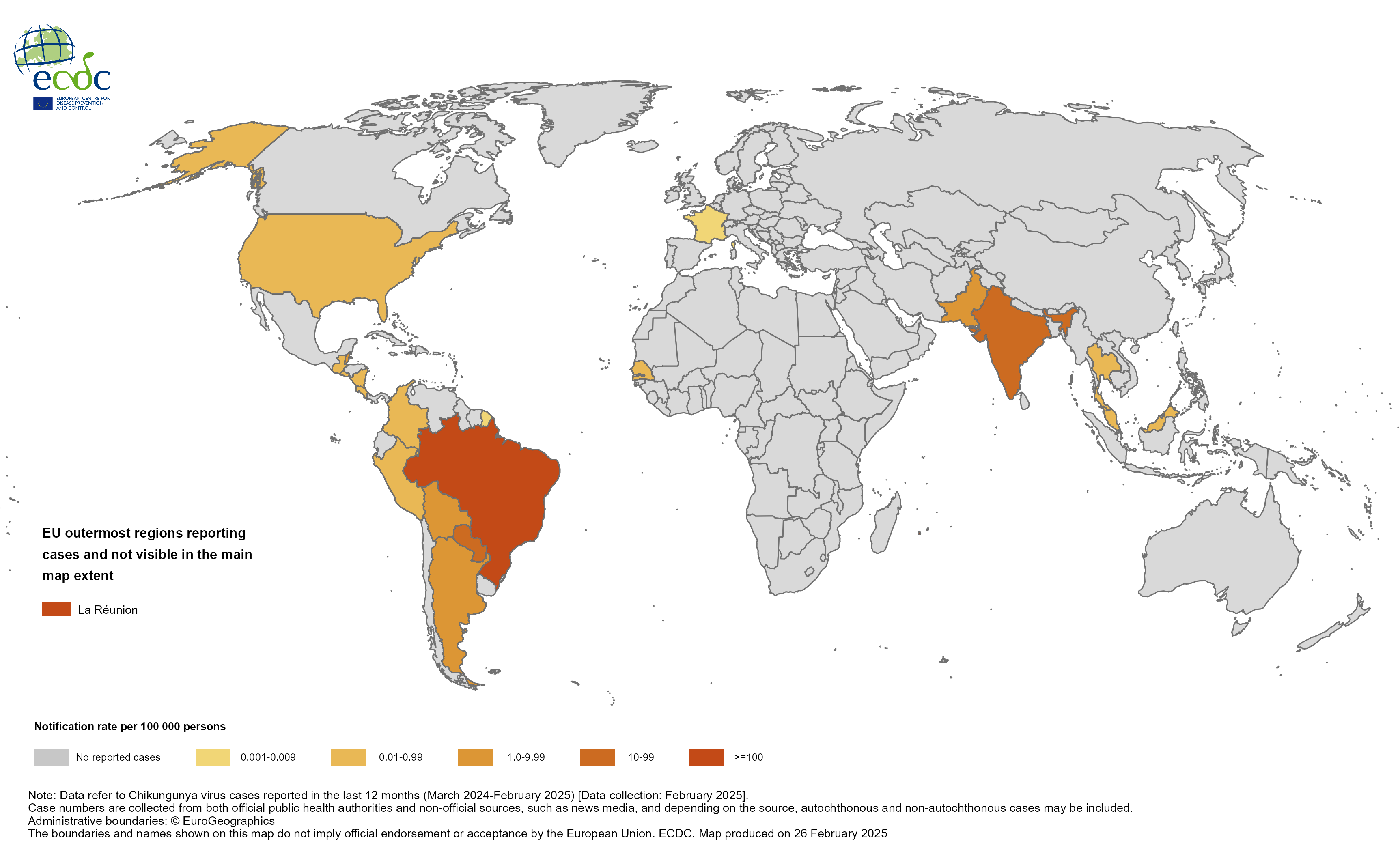
According to Eurosurveillance the highest number of recent cases have been reported in the Americas with more than 31,000 cases in Brazil and smaller numbers in Argentina, Bolivia and Paraguay. Chikungunya is not a benign disease. Fourteen chikungunya-related deaths have been reported in Brazil.
Eurosurveillance has provided a very useful map of destination specific case reports over a 12-month period (March 2024 to February 2025).
The disease is likely to be present in many locations where diagnostic tests are unavailable.
More recently, over 7,000 cases have been reported across China’s Guangdong province since July 2025, prompting local authorities to implement aggressive mosquito control measures and hospital based containment strategies. The outbreak, which is China’s largest to date, has raised concern, especially in cities like Foshan where patients are being isolated under strict conditions.
Protecting yourself against Chikungunya
The best form of prevention for Chikungunya is mosquito bite protection. This includes clothing and repellents. It is also important to be aware of the biting habits of the transmitting mosquito.
It bites mostly during daylight hours with peak activity around dawn and dusk.
Repellents - DEET, Picaridin and safe use
The repellent of choice should contain DEET (N, N-diethyl-meta-toluamide). The higher the concentration of DEET, the longer the duration of protection. However, it should be noted that the general consensus is that there is no added benefit beyond 50% DEET concentration. DEET is toxic when ingested and may cause skin irritation in some people.
If you have not used a DEET product before, or you have sensitive skin, it is advisable to test on a small area of skin before applying to larger areas of the body. DEET has been used over a long period of time, and by many millions of people with few reported serious side effects.
Despite this, a few precautions should be undertaken including safe application practices, concentration guidelines, and alternative options like Picaridin. For full details, see our Mosquito Avoidance Measures page.
New Chikungunya vaccine IXCHIQ approved in the US, Canada & Europe
A vaccine was approved by the Food and Drug Administration (FDA) in the United States in late 2023. It is manufactured by Valneva and called IXCHIQ. It is a live attenuated (weakened) vaccine providing good protection against all strains of the virus.
The vaccine is licensed for use in those over 18 years. According to CDC, it might be considered for use in travellers at high risk of exposure or those who might be at risk of serious disease. ACIP (Advisory Committee on Immunisation Practices) approved recommendations for use in travellers in February 2024.
At this stage, it should not be used in those over 60 years of age as serious side effects have been identified.
IXCHIQ has also been approved for use in Canada and more recently (July 2024) in Europe.
The length of protection is currently unknown.
Vimkunya approved in France and the US
Another vaccine, Vimkunya, has been approved for use in France in those aged 12-65 who have comorbidities. It has also been approved for use in the United States (April 2025). It is manufactured by Bavarian Nordic, a biotechnology company based in Denmark.
Information on both Chikungunya vaccines can be sourced at the US Centers for Disease Control and Prevention (CDC).
CDC provides a one page fact sheet regarding the use of the new Chikungunya vaccine.
Neither IXCHIQ or Vimkunya is available in Australia.