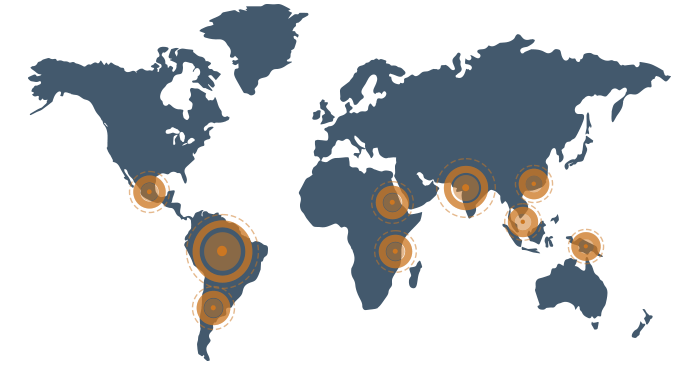
Dengue is a viral vector-borne disease transmitted to humans by a mosquito bite.
The global distribution and incidence of dengue fever has been dramatically increasing in tropical and subtropical regions over the last 20 years. Severe outbreaks are commonly reported in crowded urban and semi urban areas. More than 5 million cases were reported to the WHO in 2019. This is a gross under reporting with modelling suggesting close to 400 million cases with about 25% being symptomatic.
The disease is found in over 100 countries. The chance of dying from the more severe form, dengue haemorraghic fever (DHF) is about 5%. Previous infection increases the likelihood of developing severe dengue.
Dengue fever is caused by a virus known as a flavivirus. There are four serotypes DEN -1,2,3,4. Its presence has been noted globally for 200 years. The virus is also known as an arbovirus because it is transmitted to humans by the bite of an insect, in this case a mosquito of the Aedes species.
Aedes Aegypti mosquitoes prefer to feed on humans during the daytime. They generally live near human dwellings in an urban area. The mosquito may be found indoors and bites frequently.
One mosquito can infect many people. It remains infected for life and can also pass on the virus to the next generation.
It is known as a “junkyard” breeder because it only needs a small volume of water as a breeding site, such as empty cans, coconut shells, buckets, pot plant saucers or toys around the yard. The global expansion of the mosquito’s habitat is in line with the global increase in population density. Squatter settlements and unplanned peripheral city areas promote breeding sites particularly when local public health measures fail to keep pace with the expansion.
Global shipping trade has also spread the species to new areas and global travel enables different serotypes to be introduced into different regions through infected people.
Vaccines have been approved and licensed in several countries, but the main focus of prevention still rests on controlling vector breeding sites and reducing bites. This has proven very difficult.
The distribution of dengue is widespread, so the risk to travellers is significant. It is found in the Caribbean, the islands of the Western Pacific, Australia, Asia, Africa, and the Middle East. Outbreaks are common in the wet season in the Pacific Islands and Territories. The global impact of this disease cannot be understated.
Travel related dengue was investigated through Eurosurveillance for European travellers for the period 2015-2019. A total of 11,478 cases were identified. Most cases (71%) had travelled to Asia, but all areas of risk had cases. The rates were higher for South and Southeast Asia than the Caribbean, South America, Central America and Africa. Overall, the rate of infection was 2.8 per 100,000 travellers. It was 15.8 per 100,000 for Southeast Asia.
More than 1,000 cases of dengue have been reported in Australia in the past year (2023). This is more than the 5-year average, but this is impacted upon by travel restrictions during the COVID-19 pandemic.
In 2012, more than 140 cases of dengue were being reported per month in Australia and for the years 2010/11 in Western Australia, more than 80% cases came from Bali.
Dengue is a major concern for Australian travellers, with mosquito avoidance measures to be practiced in all locations where dengue is endemic.
According to the WHO, individuals (17-60), travelling from non-endemic countries to high burden areas might also benefit from the vaccine if they have had previous dengue. It also noted that frequent travellers or long-term expatriates may have experienced previous asymptomatic dengue and these individuals might also benefit from the vaccine.
Consideration of the vaccine should be discussed with a health professional as the use of this vaccine is only in its early stages. Several other dengue vaccines are in the pipeline.
Two dengue fever vaccines are currently available. Only one (Denvaxia) is licensed in Australia, though there are strict conditions around its use. Regulatory approval has been sort for the other, Qdenga, but this is still awaiting approval (2023).
In conjunction with repellent, it is also important to control potential breeding sites (small bodies of water) in your immediate environment.
The repellent of choice should contain DEET (N, N-diethyl-meta-toluamide). The higher the concentration of DEET, the longer the duration of protection. However, it should be noted that the general consensus is that there is no added benefit beyond 50% DEET concentration. DEET is toxic when ingested and may cause skin irritation in some people. If you have not used a DEET product before, or you have sensitive skin, it is advisable to test on a small area of skin before applying to larger areas of the body. DEET has been used over a long period of time, and by many millions of people with few reported serious side effects. Despite this, a few precautions should be undertaken:
| Concentration Of Deet | Approx. Protection Time |
|---|---|
| 30% | 8 hours |
| 15 % | 5 hours |
| 10 % (recommended for children) | 3 hours |
| 5 % | 2 hours |
Picaridin, also known as Icaridin (1-piperidinecarboxylic acid 2-(2-hydroxyethyl)-1-methylpropylester), is a new alternative to DEET, and is a non-toxic, non-penetrative solution that is considered to be environmentally friendly and suitable for anyone 2 years and above. The recommended level of Picaridin is 20-25% and lasts for around 4-6 hours before the need to reapply. A 20% concentration of Picaridin is thought to be as effective as 20-30% of DEET.