
Invasive meningitis in the Savannah Region of Ghana
Several cases of invasive meningitis have been reported in the Savannah region of Ghana. There has been one death. The area of concern lies in the north of Ghana, close to the borders of Ivory Coast and Burkina Faso.
This region is much drier than the south and prone to the Harmattan winds which blow between December and March (dry season).
The winds are responsible for clouds of dust which can cause irritation and inflammation of the airway. This may help a bacterial organism in the upper respiratory tract to become invasive.
Many cases were reported in January 2025 in the Upper West region of Ghana when conditions were similar.
The Meningitis belt of Africa
The Savannah region of Ghana lies in the “meningitis belt of Africa”
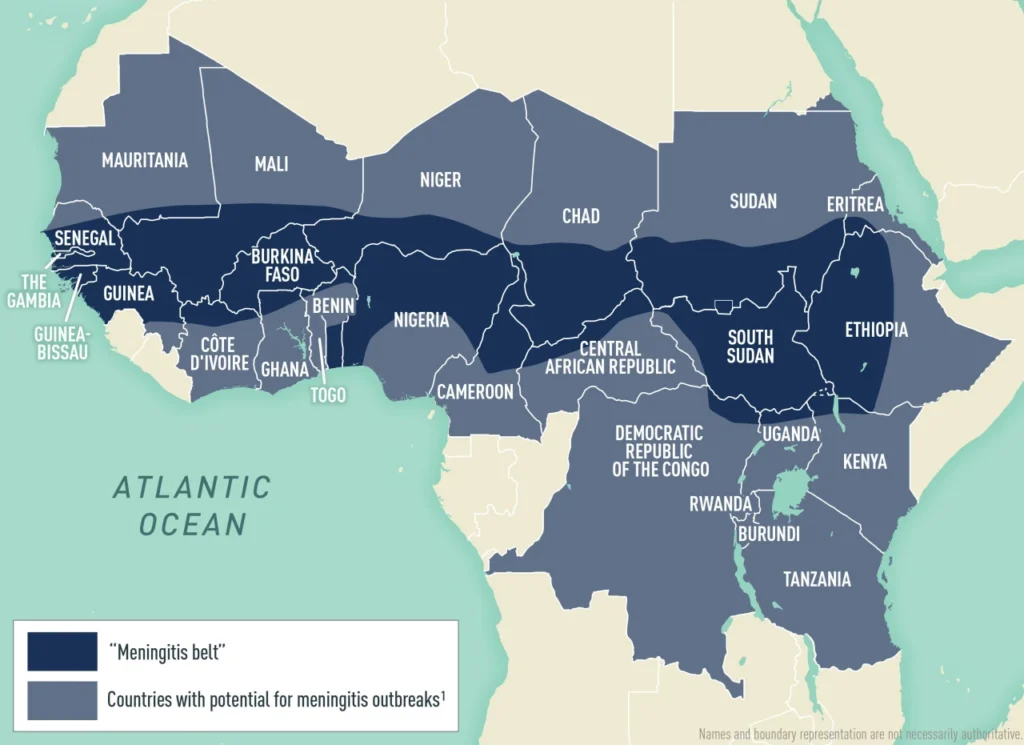 Source: CDC Yellow Book – Map 4.12.1. Disease data: World Health Organization (2015). Original available at cdc.gov
The current report is a warning for the region. Public health messaging is focused on “cough etiquette” and how the organism is transmitted through close contact.
Defeating Meningitis by 2030
The World Health Organisation (WHO) aims to eliminate bacterial meningitis by 2030 through its program “Defeating Meningitis by 2030”. Their strategy includes a vaccination program targeting 90% of the population in the countries as risk. The program includes other causes of meningitis (haemophilus influenza and the pneumococcus).
In February 2026, a young Australian traveller in Japan experienced a near death experience due to invasive meningococcal disease. This case report is a reminder that it isn’t confined to the “meningitis belt of Africa” and could happen anywhere.
What is invasive meningococcal disease (IMD)?
Invasive Meningococcal disease (IMD) is a bacterial infection which can cause serious health issues including septicaemia, meningitis, heart disease and arthritis. The bacteria colonises the upper respiratory tract before spreading to other sites. This is why it is called invasive. We don’t know why it can remain asymptomatic in some people and be invasive in others.
IMD is not a common disease, but it can have serious consequences. About 10% will die and 10-20% will have a lifelong disability. There are 12 serotypes with 5 causing the majority of IMD cases (A, B, C, W, and Y). A 6th serotype, X, has been reported in outbreaks in Africa.
How does the bacteria spread from person to person?
People transmit the disease from person to person by sharing upper respiratory tract secretions. It is usually by close contact rather than casual.
- Partners of a contact
- Close house mates (family or shared accommodation)
- College campuses, military recruits
- Microbiologists
Some health conditions can place the individual at a greater risk of disease (immune deficiency, sickle cell disease, absent or nonfunctioning spleen, HIV). Living in some locations (sub–Saharan Africa) can also increase your risk of exposure, particularly during the dry season.
How is invasive meningococcal disease prevented?
Vaccination is the key to reducing IMD. This has been an evolving strategy in Australia. The vaccines of today are vastly different to those available in 2000.
The National Immunisation Program (NIP) has been responsive as more effective vaccines became available.
- 2003: Meningococcal C conjugate vaccine recommended and funded for all children at 12 months of age.
- 2017: Meningitis ACYW conjugate vaccine available through State based programs for children at 12 months.
- 2020; Meningitis B funded for all Aboriginal and Torres Strait Islander children under 12 months and people of all ages with a poorly functioning spleen or no spleen or using a particular medication called eculizumab.
Where do we stand today?
The Meningitis ACYW vaccine is funded through the National Immunisation Program (NIP) for all adolescents aged 14-16 years.
Meningitis B is provided under some state-based programs in the first year of life (SA, QLD, NT). It is available under the NIP for certain medical conditions.
The meningitis B vaccine (Bexero) is also available in Australia in the private market.
Invasive Meningitis is a notifiable disease in Australia.
There have been more than 100 notifications in the last 12 months